A very important component of being a human being is being able to use our opposable thumbs and hold and grip objects. All age groups from babies to the elderly rely heavily on gripping and holding for everyday life and for participation in sports. Hand function and power is essential for opening jars, using cutlery, dressing, holding a cane, styling your hair, carrying groceries, cleaning, using the telephone/computer, driving, etc. Recent studies have shown that hand grip strength is reflective of longevity and overall global strength especially in the older population. We can see from the activities mentioned before how important keeping our hands strong and mobile is for everyday life and how it can affect independence with activities of daily living and even sports!
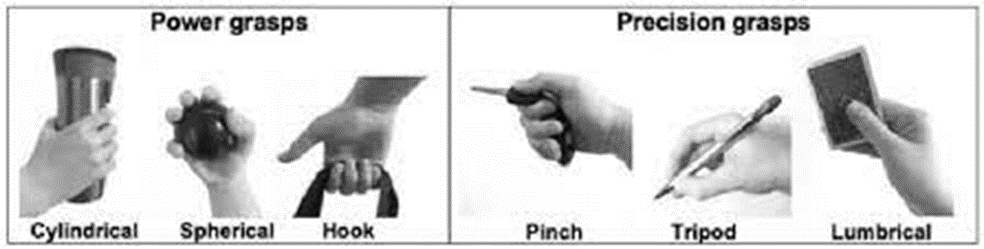
The two main grips are power and pinch grips. Power and pinch grips can be broken down into specific hand positions and muscle groups as below:
There are a few ways to measure grip strength and hand motor and dexterity. The main way is with a dynamometer and there are a few models to measure either power or pinch grip. Other assessments include: Box and Blocks test, Crawford Small Parts Dexterity test, Nine Hole Peg test and the Functional Dexterity test. Physiotherapists and Occupational therapists will use these tests to gather data to use as a baseline and track progress through rehabilitation. You will see hand tests and exercises utilized with patients following a stroke, localized hand or nerve injury, rheumatoid arthritis, spinal cord injury, multiple sclerosis, deconditioning, etc.
On the flip side, the general population and athletes can always do with improving their hand strength to reduce frailty as we age and to aid performance. Usually, you hear about only rock climbers training their grip strength, however, gymnasts, musicians, badminton players, office and construction workers, etc should take extra time to improve their grip strength to reach full potential. Your forearms, hands and fingers can handle high load/weight and repetitions, for example performing pull-ups or deadlifts and using a screwdriver or washing dishes. This area of the body is very complex due to the many joints, muscles and ligaments but can provide strength and endurance and adapt to any shape or unique task.
If you want to step up your hand grip strength game or get tested to see how you measure up, come visit your friendly neighborhood physiotherapist and they can help you take a baseline test and provide some exercise ideas.
Lee, S.-C., Wu, L.-C., Chiang, S.-L., Lu, L.-H., Chen, C.-Y., Lin, C.-H., Ni, C.-H., & Lin, C.-H. (2020). Validating the capability for measuring age-related changes in grip-force strength using a digital hand-held dynamometer in healthy young and elderly adults. BioMed Research International, 2020, 1–9. https://doi.org/10.1155/2020/6936879
Porto, J. M., Nakaishi, A. P. M., Cangussu-Oliveira, L. M., Júnior, R. P., Spilla, S. B., & De Abreu, D. C. C. (2019). Relationship between grip strength and global muscle strength in community-dwelling older people. Archives of Gerontology and Geriatrics, 82, 273–278. https://doi.org/10.1016/j.archger.2019.03.005
Proulx, C. E., Beaulac, M., David, M., Deguire, C., Haché, C., Klug, F., Kupnik, M., Higgins, J., & Gagnon, D. H. (2020). Review of the effects of soft robotic gloves for activity-based rehabilitation in individuals with reduced hand function and manual dexterity following a neurological event. Journal of Rehabilitation and Assistive Technologies Engineering, 7, 205566832091813. https://doi.org/10.1177/2055668320918130
–Alison Parker, Registered Physiotherapist

Book with her here!